2003
Pair, 72” x 9” each piece
Poly-spandex, mirrored plexi-glass, clear acrylic medium, painted wood frame on masonite backing, steel frames.
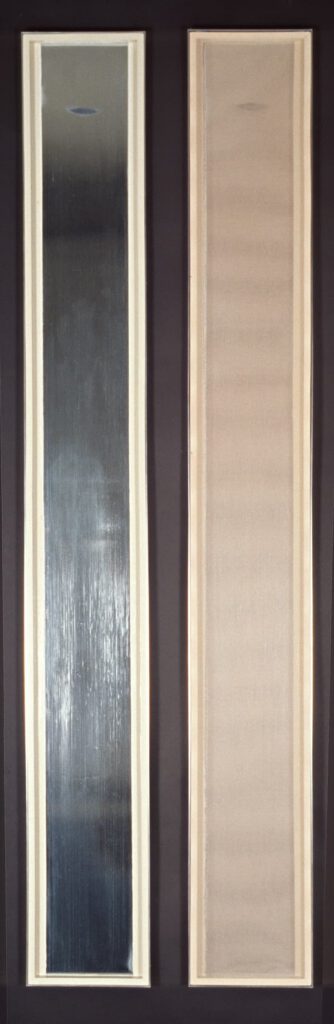

While several other smaller works about genetic gel slide studies were made at later dates, Radtke considers “Transference” (2003) to be the final work of the DNA Series, making a conceptual shift from the scientific focus toward the presence of the human body and the onset of the Identity Series to come. While retaining the vertical format referencing chromosomal gel slides and pairings, this piece replaces the delicate silk filter with flesh-toned poly-spandex. This new, body-like material is porous and designed to stretch, allowing light to pass through obscurely and functioning as a yieldable, human “skin”. The two lanes are lined with mirrored plexiglass, a new material introduction, coated with a film of clear gel medium applied in a single downward stroke, suggesting a sense of liquid, biological flow. A single, fugitive genetic marker appears near the top of each mirror. The mirrored left lane remains open, offering the viewer a distorted reflection, filtered by the gel medium. In direct contrast, the right lane is stretched taut with the flesh-toned poly-spandex, completely obscuring the viewer’s potential reflection, shifting the focus from objective genetic data to the subjective, veiled nature of human identity.
Collections:
Mr. and Mrs. Bruce Capra, New Canaan, CT
Pair, 72” x 9” each piece
Poly-spandex, mirrored plexi-glass, clear acrylic medium, painted wood frame on masonite backing, steel frames.